
Long-term contracts under FRS 102 (September 2024)
 The Financial Reporting Council (FRC) issued its amendments to FRS 102 The Financial Reporting Standard applicable in the UK and Republic of Ireland in March 2024. The amendments become mandatory for accounting periods commencing on or after 1 January 2026.
The two headline changes, of course, relate to lease accounting and revenue recognition. This article examines how long-term contracts may be affected under FRS 102 (September 2024), Section 23 Revenue from Contracts with Customers, which contains a comprehensive five-step recognition model as follows:
- Step 1: Identify the contract(s) with a customer
- Step 2: Identify the performance obligations in the contract
- Step 3: Determine the transaction price
- Step 4: Allocate the transaction price to the performance obligations in the contract
- Step 5: Recognise revenue when (or as) the entity satisfies a performance obligation
At the outset, it is worth emphasising that the examples contained in this article are for illustrative purposes only which aim to show how the accounting treatments differ.
Current accounting treatment for long-term contracts
FRS 102 (January 2022), para 23.17 says that if the outcome of a contract can be estimated reliably, the entity recognises contract revenue and contract costs having regard to the stage of completion of the contract activity at the balance sheet date.
This treatment effectively means that where an entity applies an output method, gross profit margins within the contract may remain consistent over the period of the contract because of the stage of completion method.
| Example – Accounting treatment under FRS 102 (January 2022)
Sunnie Enterprises Ltd enters into a three-year contract to construct an office and warehouse facilities at a contract price of £6 million. For simplicity, Sunnie Enterprises recognises revenue on an output method using straight-line recognition of £2 million per annum. Contract costs are as follows: · Year 1: £1.8 million · Year 2: £1.9 million · Year 3: £1.1 million Total costs over the three-year duration are £4.8 million.
The gross profit margin on the contract is 20% (£1.2m gross profit / £6m contract price). Under FRS 102 (January 2022), based on an output method, Sunnie Enterprises will recognise revenue, costs and work in progress as follows:
|
|||||||||||||||||||||||||||||||||||||||||||||||||||
Treatment under FRS 102 (September 2024)
Following the periodic review of FRS 102, the FRC completely redrafted Section 23 to incorporate a five-step revenue recognition model so that FRS 102, Section 23 is more aligned to IFRS® 15 Revenue from Contracts with Customers. Revenue continues to be recognised either at a point in time or over time. There are three criteria, of which at least one must be met, to establish that an entity satisfies performance obligations over time:
| a) the customer simultaneously receives and consumes the benefits provided by the entity’s performance as the entity performs (eg routine or recurring services such as a cleaning service). If an entity cannot readily identify whether this is the case, a performance obligation is satisfied over time if another entity would not need to substantially re-perform the work that the entity has completed to date if that other entity were to fulfil the remaining performance obligation (eg in a freight logistics contract);
b) the entity’s performance creates or enhances an asset that the customer controls as the asset is created or enhanced (eg in the case of a construction contract in which the customer controls the work in progress); or c) the entity’s performance does not create an asset with alternative use to the entity (see paragraphs 23.82 to 23.83) and the entity has an enforceable right to payment for performance completed to date (see paragraph 23.84). [FRS 102, para 23.81 (extract)] |
In all other cases, revenue is recognised at a point in time.
Contract costs
There are two types of contract costs that an entity will need to consider:
- Costs to obtain a contract; and
- Costs to fulfil a contract.
Costs to obtain a contract
Before an entity applies the cost requirements in FRS 102, Section 23, it will need to consider certain issues.
If payment is made to a customer, the entity will need to consider whether the requirements on consideration payable to a customer under Section 23 applies to those costs. See FRS 102, paras 23.62 to 23.64.
Where Section 23 does apply to the costs to obtain a contract, there is an accounting policy choice available that allows the entity to either expense the incremental costs of obtaining a contract with a customer; or to recognise such costs as an asset if the entity expects to recover them. The term ‘incremental costs’ relates to those costs that the entity would not have incurred if the contract had not been obtained. Costs to obtain a contract should be recognised as an asset if they are charged to the customer, regardless of whether the contract is won or not.
FRS 102, para 23.114 states that where the entity adopts a policy of recognising costs to obtain a contract as an asset, that policy must be applied consistently to all costs which meet the recognition criteria in para 23.113. The exception relates to those incremental costs which the entity would recognise as an asset with an amortisation period of one year or less; such costs may be expensed when incurred. Any costs which do not meet the asset recognition criteria are recognised as an expense when incurred.
Costs to fulfil a contract
Under FRS 102 (September 2024), costs are not recognised in proportion to the stage of completion of the contract. They are generally recognised in profit or loss as they are incurred. There are some exceptions to this principle relating to certain costs to obtain or fulfil contracts which are outlined in FRS 102, para 23.116 such as recognising those costs within inventories (Section 13), property plant and equipment (Section 17) or intangible assets (Section 18).
FRS 102, Section 23 is clear that any other applicable sections of FRS 102 such as Sections 13, 17 or 18 must be considered first.
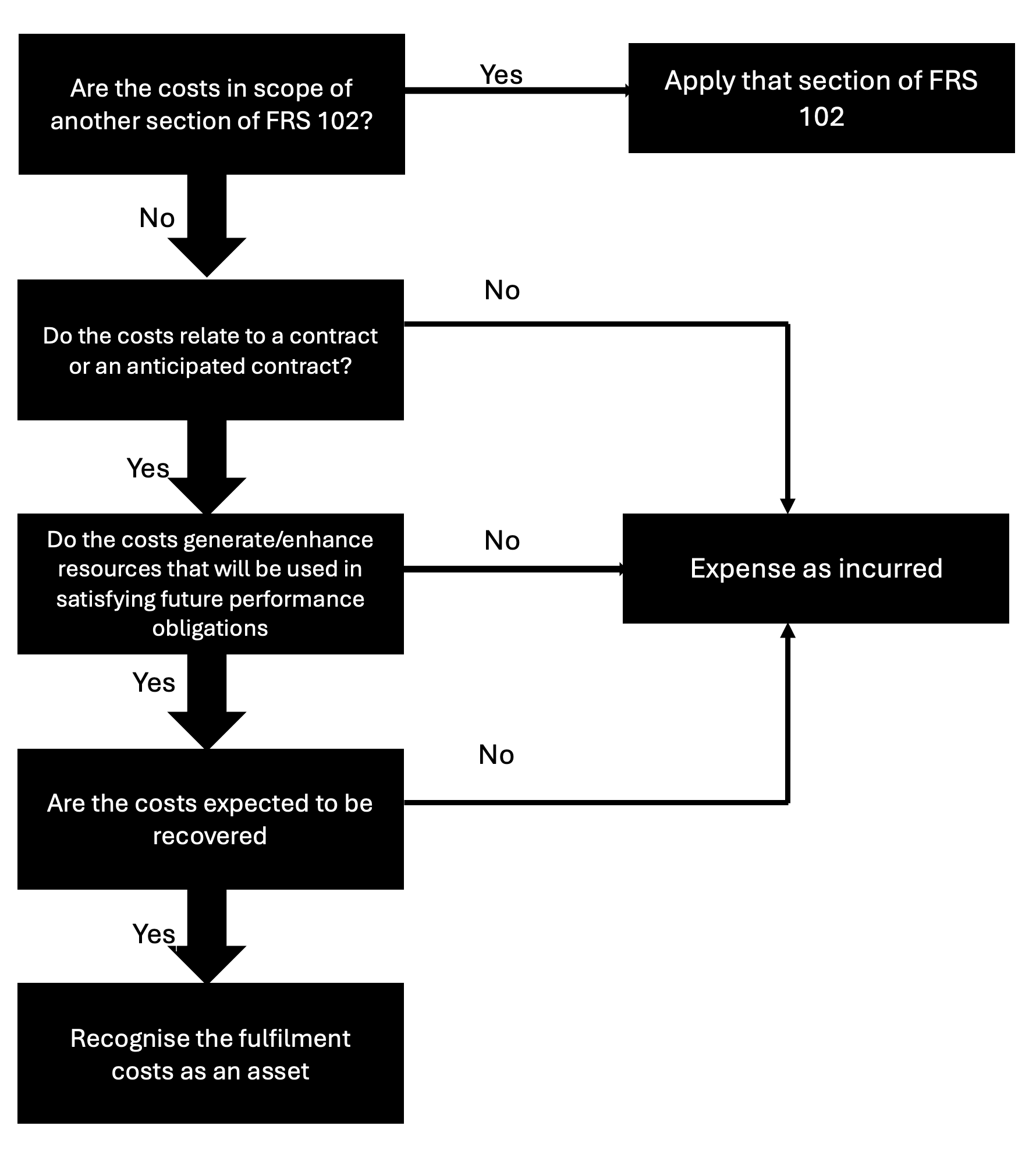
Where the costs incurred to fulfil a contract are not within scope of another section of FRS 102, an entity can only capitalise such costs if they meet all of the following criteria:
- The costs directly relate to a contract or to a specifically identifiable anticipated contract which the entity can specifically identify.
- The costs generate or enhance resources of the entity that will be used in satisfying, or in continuing to satisfy, performance obligations in the future.
- The costs are expected to be recovered.
An overview of the treatment of costs is shown in the following flowchart (click on the flowchart to zoom in):
The upshot of this revised treatment for contract costs is that gross profit margins are unlikely to remain fixed over a contract term.
Going back to the example above, we can assess the impact of the revised treatment as follows:
| Example – Accounting treatment under FRS 102 (September 2024)
Sunnie Enterprises Ltd enters into a three-year contract to construct an office and warehouse facilities at a contract price of £6 million. For simplicity, Sunnie Enterprises recognises revenue on an output method using straight-line recognition of £2 million per annum. Contract costs are as follows: · Year 1: £1.8 million · Year 2: £1.9 million · Year 3: £1.1 million Total costs over the three-year duration are £4.8 million.
The gross profit on the contract is 20% (£1.2m gross profit / £6m contract price). Under FRS 102 (September 2024), based on an output method, Sunnie Enterprises will recognise revenue, costs and work in progress as follows:
As can be seen from the above, gross profit margins are not consistent during the contract (as they were in the previous example); but the entity ends up achieving the overall gross margin within the contract on completion. The idea behind this is that the new accounting treatment for costs ensures that reported contract margins are based on ‘real’ contract performance rather than a ‘smoothed’ stage of completion performance. |
|||||||||||||||||||||||||||||||||||||||||||||||||||||||||
Conclusion
FRS 102 (September 2024), Section 23 is a very detailed section and entities cannot under-estimate the work involved in ensuring correct compliance with the five-step revenue recognition model. There are certain technical issues that may not seem immediately obvious which can, in some cases, result in very different revenue amounts being recognised.
Category: Accounting and standards, Audit


