
Accounting for basic bank loans with arrangement fees under FRS 102
 A common question asked by practitioners is how to treat transaction costs that arise when a client takes out a bank loan.
FRS 102 The Financial Reporting Standard applicable in the UK and Republic of Ireland deals with financial instruments in Section 11 Basic Financial Instruments. It is fair to say that Section 11 is a complex section to understand and some of the terminology used in the section can be difficult to interpret.
In developing FRS 102, Section 11, the Financial Reporting Council (FRC) have included various examples to aid clarity, and the examples are very useful.
The term ‘transaction costs (financial instruments)’ is defined in the Glossary to FRS 102 as:
| Incremental costs that are directly attributable to the acquisition, issue or disposal of a financial asset or financial liability, or the issue or reacquisition of an entity’s own equity instrument. An incremental cost is one that would not have been incurred if the entity had not acquired, issued or disposed of the financial asset or financial liability, or had not issued or reacquired its own equity instrument. |
In terms of initial recognition of a financial asset or a financial liability, FRS 102, para 11.12 states that an entity recognises such an instrument only when the entity becomes a party to the contractual provisions of the instrument.
Initial measurement of a loan
FRS 102, para 11.13 deals with initial measurement of a loan. This paragraph states:
| When a financial asset or financial liability is recognised initially, an entity shall measure it at the transaction price (adjusted for transaction costs except in the initial measurement of financial assets and liabilities that are subsequently measured at fair value through profit or loss) unless the arrangement constitutes, in effect, a financing transaction. An arrangement constitutes a financing transaction if payment is deferred beyond normal business terms or is financed at a rate of interest that is not a market rate, for example, providing interest-free credit to a buyer for the sale of goods or an interest-free or below market interest rate loan made to an employee. Except as set out in paragraph 11.13A, if the arrangement constitutes a financing transaction, the entity shall measure the financial asset or financial liability at the present value of the future payments discounted at a market rate of interest for a similar debt instrument as determined at initial recognition adjusted for transaction costs. |
At initial recognition, the loan will be measured at fair value which will usually be the transaction price.
Hence, for a basic bank loan measured at amortised cost under FRS 102, Section 11, the liability is initially recognised net of transaction costs. This is further elaborated upon in the examples contained within FRS 102, para 11.13, one of which states:
| For a loan received from a bank at a market rate of interest, a payable is recognised initially at the amount of the cash received from the bank less separately incurred transaction costs. |
Some practitioners recognise loan arrangement fees, for example, in profit or loss as they have arisen. Other practitioners recognise such fees in prepayments and release them to profit or loss over the life of the loan. These treatments are inconsistent with the requirements of FRS 102. The loan arrangement fees should be included in the loan amount initially recognised and this balance is then accounted for under the amortised cost method which uses an effective interest rate.
| Example – Initial recognition and subsequent measurement of a loan
An entity takes out a five-year bank loan of £750,000. The bank charges a 1.25% loan arrangement fee which is non-refundable and is payable on inception of the loan. The loan is initially recorded as follows:
The loan is then subsequently measured using the amortised cost method, which uses the effective interest rate. In this example, the effective interest rate has been calculated at 3.71% using the Goal Seek function in Microsoft Excel. For simplicity, the repayments in the table below have been annualised.
In year 1, the journals to record the loan are:
The loan is then split between the portion falling due within one year of £142,640 (£603,084 – £460,444) and the portion falling due after more than one year of £460,444 to comply with the statutory formats of the balance sheet.
|
||||||||||||||||||||||||||||||||||||||||||||||||||||||||||||||||||||||||||||||||||
If we assume that the preparer has debited the loan arrangement fee to the profit and loss account, i.e.:
|
£ |
|
| Dr Bank |
740,625 |
| Dr P&L |
9,375 |
| Cr Loan |
750,000 |
The interest charges to profit and loss will be affected because the effective interest rate will essentially be lower (i.e. the effective interest rate will be 3.26% rather than 3.71%) as can be seen in the following table:
|
This will also mean that the loan has not been accounted for in accordance with FRS 102, Section 11.
Effective interest rate
A quick way of proving the effective interest could be to use the Internal Rate of Return function in Excel. Using the figures in the correct example above, this is how you would do it:

The formula to use in cell B7 would be =IRR(A1:A6). Make sure you have cell B7 formatted to be a percentage.
Amortised cost method in Excel
Alternatively, (and probably more easier) is to use the Goal Seek function in Microsoft Excel to deal with the loan. This is done by profiling the loan as follows:

For clarity, the formulas used in the above are as follows:

Hence, cell C2 will be used to calculate the effective interest rate.
To use the Goal Seek function in Excel, go to the Data tab, select ‘What-if Analysis’ and then Goal Seek. A box will appear and you will enter the following information:
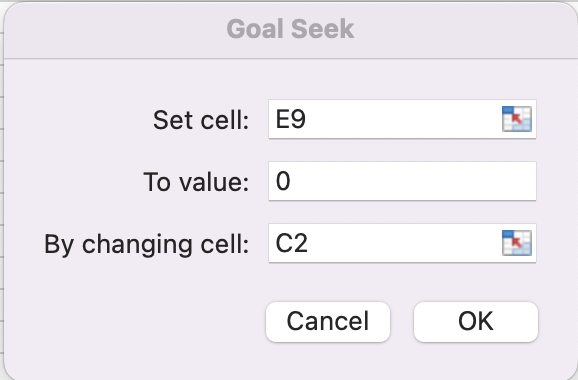
When you click ‘OK’, Excel automatically calculates the effective interest rate for you as follows:

Conclusion
For most basic bank loans which incur arrangement fees, the amortised cost method will apply and hence the arrangement fee is taken directly to the loan account on initial recognition and not to profit or loss or prepayments. The arrangement fee is then recognised in profit or loss over the life of the loan. The exception to this rule would be where the loan is being measured at fair value through profit or loss as the fee would be expensed immediately because the payment does not result in any future economic benefit.
Category: Accounting and standards, Audit


