
Basic bank loans and loan arrangement fees
 Many businesses take out loans for a variety of reasons. Some will take them out to provide working capital; others may take them out to acquire fixed assets and others may take them out to acquire another business. Whatever the reason, the loan must be accounted for correctly in accordance with accounting standards.
This article considers the accounting requirements of FRS 102 The Financial Reporting Standard applicable in the UK and Republic of Ireland and the accounting requirements for a basic bank loan.
FRS 102, Section 11 Basic Financial Instruments requires basic financial instruments to be measured using the amortised cost method, which uses an effective interest rate.
FRS 102, para 11.15 states that the amortised cost of a financial asset or a financial liability at the balance sheet date is the net of the following amounts:
(a) the amount at which the financial asset or financial liability was initially recognised;
(b) minus any repayments of the principal;
(c) plus, or minus, the cumulative amortisation using the effective interest method of any difference in the amount at initial recognition and the maturity amount; and
(d) minus, in the case of a financial asset, any reduction (directly or through the use of an allowance account) for impairment or uncollectability.
The effective interest method is a means of calculating the amortised cost of a financial asset or financial liability (or groups of financial assets and financial liabilities) and allocating the interest income or expense over the life of the instrument. The ‘effective interest rate’ is the rate which exactly discounts estimated future cash receipts or payments through the expected life of the instrument or, when appropriate, a shorter period, to the carrying amount of the instrument.
An efficient way of applying the effective interest method is to use the Goal Seek function in Microsoft Excel as this will calculate both the effective interest rate and the value of interest expense or income that is to be recognised over the life of the instrument.
| Example – Amortised cost method using Excel | ||||||||||||||||||||||||||||||||||||
| Westhead Limited takes out a loan to purchase an item of machinery for £35,000. The term of the loan is for five years. Monthly payments are £685 and there is an administration fee payable at the end of year five amounting to £150 which is included in the final payment. The company has not incurred any arrangement fees in connection with this loan.
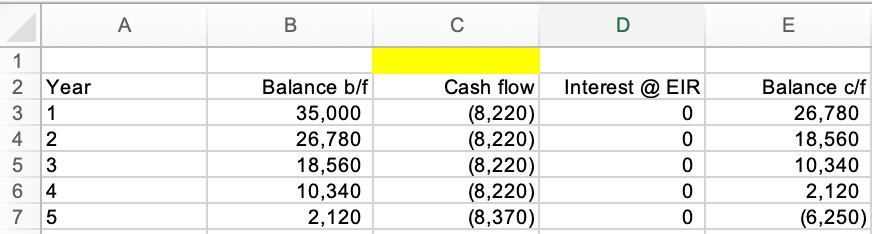
In years one to four, the company will pay £8,220 (£685 x 12) and in year five it will pay £8,370 (£685 x 12 + £150). The loan is profiled as follows (click on image to zoom in):
The formulas in the above spreadsheet are shown below (click on the image to zoom in):
We can use the Goal Seek function to set cell E7 to a value of zero by changing cell C1 as follows: Go to the Data tab (as shown below) and then ‘What-if Analysis’ (click on the image to zoom in):
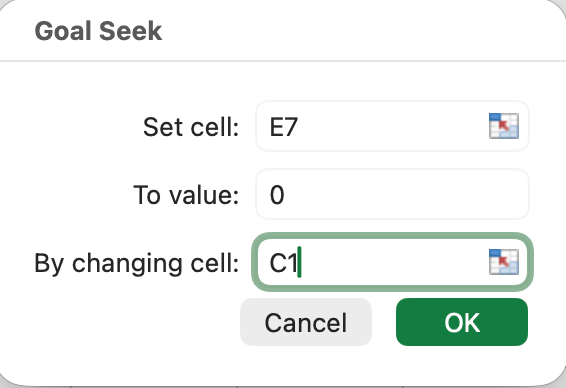
Go to ‘Goal Seek’ and enter the following information:
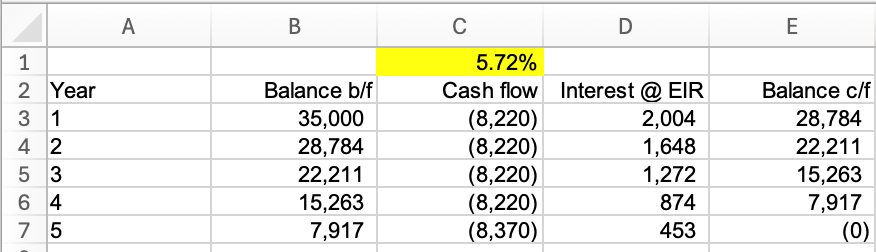
Once we click ‘OK, the spreadsheet calculates the effective interest rate as follows:
The effective interest rate in the above has been calculated at 5.72% and is allocated to each period during the term of the loan. The interest charges are higher in the earlier years of the loan and lower in the later years. In contrast, the ‘level spread’ method (a method not recognised in FRS 102) would have charged an amount of £1,250 per annum over the life of the loan (£41,250 less £35,000 / 5 years). In year 1, the journals are as follows:
At the end of year 1, the loan would be presented in the balance sheet as a current liability of £6,573 and a long-term liability of £22,211 to comply with the statutory formats of the balance sheet. |
||||||||||||||||||||||||||||||||||||


Loan arrangement fees
A common question asked by practitioners is how to treat transaction costs that arise when an entity takes out a bank loan or other form of finance that attracts an arrangement fee.
FRS 102, para 11.13 contains an example of an entity that takes out a bank loan and states:
For a loan received from a bank at a market rate of interest, a payable is recognised initially at the amount of the cash received from the bank less separately incurred transaction costs.
Some practitioners have recognised loan arrangement fees, for example, in profit or loss as they have arisen. Other practitioners have recognised such fees in prepayments and released them to profit or loss over the life of the loan. These treatments are inconsistent with the requirements of FRS 102 and are technically incorrect. The loan arrangement fees are included in the loan amount initially recognised and this balance is then accounted for under the amortised cost method which uses an effective interest rate. Hence, the transaction cost is recognised in profit or loss over the life of the loan via the amortised cost method as follows:
| Example – Initial recognition and subsequent measurement of a loan | ||||||||||||||||||||||||||||||||||||||||||||||||||||||||||||||||||||||||||||||||||||
| Dwyer Ltd takes out a five-year bank loan of £750,000. The bank charges a 1.25% loan arrangement fee which is non-refundable and is payable on inception of the loan.
The loan is initially recorded net of the transaction cost of £9,375 (£750,000 x 1.25%) as follows:
The loan is then subsequently measured at amortised cost using the effective interest rate. In this example, the effective interest rate has been calculated at 3.71% using the Goal Seek function (see above). For simplicity, the repayments in the table below have been annualised.
In year 1, the journals to record the loan are:
|
||||||||||||||||||||||||||||||||||||||||||||||||||||||||||||||||||||||||||||||||||||
Effect of an incorrect accounting treatment
If we assume that the loan arrangement fee has been debited to the profit and loss account, i.e.:
|
£ |
|
| Dr Bank |
740,625 |
| Dr P&L |
9,375 |
| Cr Loan |
750,000 |
The interest charges to profit and loss will be affected because the effective interest rate will essentially be lower (i.e. the effective interest rate will be 3.26% rather than 3.71%) as can be seen in the following table:
| Illustration – Incorrect accounting treatment | |||||||||||||||||||||||||||||||||||
|
This will also mean that the loan has not been accounted for in accordance with FRS 102, Section 11.
Proving the effective interest rate
A quick way of proving the effective interest could be to use the Internal Rate of Return function in Excel. Using the figures in the correct example above, this is how you would do it:

The formula to use in cell B7 would be =IRR(A1:A6). Make sure you have cell B7 formatted to be a percentage.
Interest-only loans
Another common question asked by accountants is how an interest-only loan should be recorded in the financial statements under FRS 102. In an interest-only loan, loan repayments over the term of the loan are simply interest only, with the capital (principal) element being paid back in one lump-sum at the end of the loan term.
FRS 102 would still require the amortised cost method to be applied as this is the only method under Section 11.
| Example – Interest-only loan | ||||||||||||||||||||||||||||||
| Ratchford Enterprises Ltd takes out a £500,000, five-year interest-only bank loan out on 2 January 2025. Interest on the loan is at 6%, paid annually in arrears on 31 December. The full £500,000 principal amount is to be repaid on 31 December 2030. The bank has charged a non-refundable arrangement fee of £5,000 which has been paid at the start of the loan.
Initial recognition The loan amount is initially recognised net of the arrangement fee as follows:
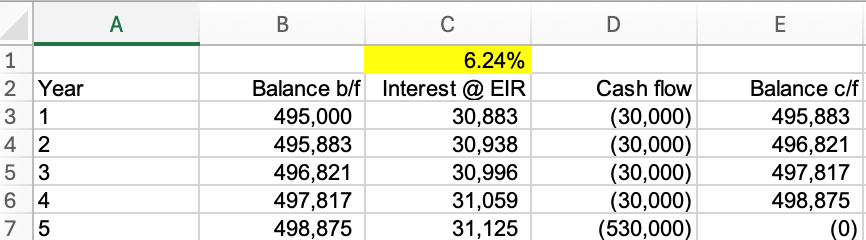
Remember, the loan arrangement fee is capitalised into the loan balance and amortised through profit and loss using the effective interest method. It is not expensed immediately. If it is incorrectly expensed via profit and loss immediately, the finance cost charged to profit and loss under the effective interest method will be incorrect. Expected cash flows in the loan The expected cash flows in the loan are as follows: · Years 1 to 5 (annual interest): £500,000 x 6% = £30,000 per annum · Year 5 (principal repayment): £500,000 Profile the loan and use the Goal Seek function in Excel to calculate the effective interest rate (EIR)
Record the journal entries in each year of the loan To recognise the cash flow (payments of interest)
To recognise the interest at EIR:
The difference between the effective interest expense (£30,883) and the cash interest paid (£30,000) is the amortisation of the initial transaction costs. This increases the loan liability over the term of the loan so that it reaches the maturity amount of £500,000 at the end of the loan term. This method ensures that the total finance costs recognised in profit or loss over the five years equals the total cash interest paid (£150,000) plus the initial transaction cost (£5,000), allocated at a constant rate over the life of the loan. |
||||||||||||||||||||||||||||||
Conclusion
Loan arrangement fees and interest-only loans can cause an element of confusion among preparers. This is particularly the case when recognition methods other than the amortised cost and effective interest method have historically been applied. Remember, for basic instruments such as straightforward bank loans, finance leases and hire purchase contracts, FRS 102 only recognises the amortised cost method, which uses an effective interest rate.
Category: Accounting and standards


